Mostrando postagens com marcador English. Mostrar todas as postagens

quinta-feira, 18 de maio de 2017

The farthest source of X-rays ever discovered has become a great mystery


Astronomers search for X-ray sources in the Universe over sixty years, and it can be seen in stars, gas clouds, destructive events ... and everything got a little easier after the deployment of space telescopes dedicated to observations As is the case with the Chandra Observatory.

Since its launch on July 23, 1999, Chandra has been NASA's primary X-ray instrument. But on March 30, 2017, Chandra was able to draw even more attention from astronomers.

Using its set of advanced instruments, the observatory captured a mysterious glow from deep space. This brightness would become the most distant source of X-ray ever seen, and in addition, something entirely new.


Located in the sky region known as Chandra Deep Field-South (CDF-S), this X-ray emission source appears to have come from a small galaxy located about 10.7 billion light years from Earth. It also had some remarkable properties, such as producing (in a matter of seconds) more energy than all the stars in a galaxy.

By 2014, a team of researchers at Penn State University, Chilean PUC, had already detected such a source, but not through X-rays. But still, it caught the attention of the team because during a rash it became about 1,000 times brighter in a matter of hours. From there, researchers began collecting data using the advanced Chandra Observatory spectrometer.

After being detected during an intense glow, the X-ray source became dim and disappeared, but astronomers had enough time to record information with the Hubble and Spitzer space telescopes. Now, thousands of data will be analyzed to determine the exact location, but you can already see that it is the most distant X-ray source ever detected so far! On the other hand, it is not known what would have caused immense brightness and emission of energy.


The mysterious source of X-rays could be the result of some kind of destructive event, or something that scientists have never seen before. And the strangest thing is that such X-ray bursts are usually followed by bursts of gamma rays, which seems to be missing in this case.

So far, three possible explanations for the strange origin of this phenomenon have been suggested: in the first, the X-ray source (called CDF-S) is in fact the result of a star collapsing or melting, The resulting gamma are not pointed at Earth; In the second hypothesis, the same scenario is responsible for the X-ray source, but the gamma-ray burst is beyond the small galaxy; And the third possible explanation would be that the event would have been caused by a medium-sized black hole during the destruction of a white dwarf star.

During the 17 years of operation of the Chandra Space Observatory, astronomers had never seen anything like it. An X-ray source like this has never been observed by any other observatory anywhere in the Universe. In addition, this phenomenon occurred faster and in a smaller galaxy than other unexplained events previously observed.


In the end, the most plausible (but not 100% reliable) explanation is that the event was probably the result of something cataclysmic, such as a neutron star or a white dwarf being shattered. But the fact that the data does not match this or any other explanation makes it appear that astronomers have witnessed a whole new kind of cataclysmic event.

Both Chandra and other observatories operating on the X-ray, such as ESA's XMM-Newton and NASA's Swift Gamma-Ray Burst, will make further searches to find other examples of similar events. We have to hope for the unlikely to happen again.

sexta-feira, 12 de maio de 2017

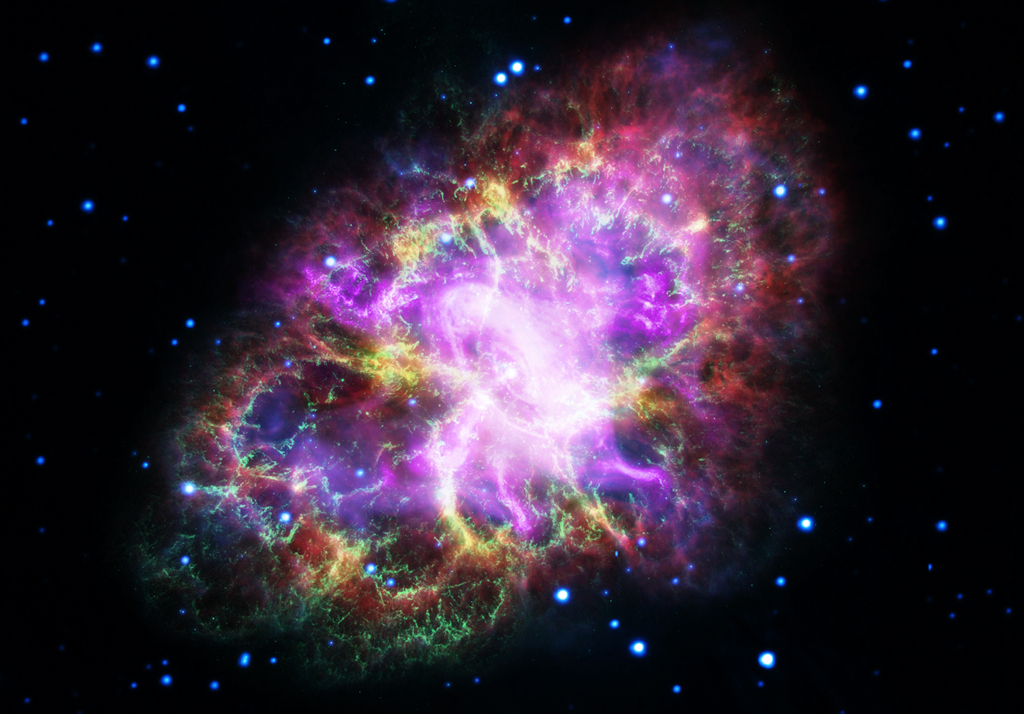
Crab at various wavelengths


This is the M1, also known as the Crab Nebula, which is about 6,500 light-years away from Earth, towards the constellation of the Taurus.

It's a supernova remnant.
Supernova light was observed from Earth in the year 1054.
After the explosive death of the massive star, the cloud of debris was expanded to the configuration we see in the image.

The image shows the nebula at various wavelengths: X-rays (Chandra), ultraviolet (XMM-Newton), visible (Hubble), infrared (Spitzer), and radio (Very Large Array). Respectively in purple, blue, green, yellow and red colors.

At the center of the image is the result of the collapse of the core of the original star: the Pulsar of the Crab, a neutron star that rotates 30 times per second.


sexta-feira, 5 de maio de 2017

Black hole with cardiac arrhythmia


The supermassive black holes identified in the center of most galaxies can be compared to a heart.

They, through the jets they expel, end up injecting energy and material into the galaxy that hosts them. This has important consequences throughout the evolutionary process of galaxies.

To understand this process, astronomers have decided to study the galaxy NGC 4696, located 145 million light years from Earth and that has a supermassive black hole inside.

Astronomers have studied the galaxy and its black hole using the Chandra Space Telescope, and looking closely at the X-ray emissions from the galaxy.

This galaxy is a giant elliptical galaxy located in the middle of a cluster of galaxies.

By studying the emissions, astronomers have discovered vast cavities in the hot gas that fills the space between the galaxy clusters.

Emissions have also created shock waves that travel through the clump.
The heartbeat of the central galaxy happens every 5 or 10 million years, meaning it is as if this galaxy suffered from cardiac arrhythmia.


This study clearly shows that in addition to influencing the evolution of its host galaxy, the supermassive black hole influences the entire cluster.

These gas cavities and shock waves carry elements from side to side, enrich certain areas with heavier elements, while others, especially those near the black hole, are poor in heavy elements but rich in lighter elements.

In addition, the black hole emissions heat the gas, preventing it from cooling, that is, regulating the star formation process itself.

The symbiotic relationship between a supermassive black hole and a galaxy is one of the great mysteries of astrophysics today.

In addition, it can be seen that this relationship affects not only the galaxy, but the whole environment where it is inserted and even a whole cluster of galaxies.

Really black holes are intriguing and important figures in the entire process of evolution of the universe.

ALMA reveals dust sandwich around young star


ALMA is revolutionizing various areas of astronomy, but the one that he may be contributing most to is the study of dust discs around newly formed stars.

The power of observation, and the specific wavelength at which he observes these objects, allows him to solve with incredible precision these structures of paramount importance in understanding the process of planetary formation.

Recently a group of astronomers used the ALMA, pointed it to a young star, and watched its protostellar disk.
That alone would be fantastic, since it was thought that at the beginning of the life of a star she would not be able to form this type of disc, due to the great magnetic activity.

But the amazing things do not stop there.
The star studied is known as HH 212, located in Orion, about 1300 light-years away from Earth.
The central protoestrela is only 40,000 years old and has a mass equivalent to 1/5 of the mass of the Sun.

Earlier studies had shown that this protoestrel had an accretion disk around it, but with ALMA, astronomers were able to see this disk in detail and observe important features.

Astronomers not only observed the disk in its lateral extension, but could also see its vertical extent.

The disk has 60 AU of radius and shows a dark line in its equatorial region, which makes it resemble a sandwich.

This observation of the ALMA opens another important window in the observation of the accretion discs around protostares, besides rewriting the theory of formation of these disks.

The ALMA, with its impressive resolution, allows you to observe the vertical structure of the disks, which causes astronomers to have ideas about how the grain growth process happens, which is important in the early stages of planetary formation.

With the ALMA you can see how the process of planet formation occurs from the very beginning, or even before it begins.

Did a comet hit the Earth in 10950 BC?


How about mixing some archeology with astronomy?

Before there was paper or the internet to spread the astronomical events, the humans who lived thousands of years ago wrote their observations on the rocks.

There are countless cave paintings relating to celestial events, such as the crab supernova, written and described in rocks by the Chinese people.

The science that integrates archaeological studies with astronomical events, receives the name of archeoastronomy.

Recently, a group of researchers discovered rock-carved evidence that a catastrophic astronomical event occurred on Earth long ago.

Prior to the archaeological evidence, analysis of samples taken in Greenland suggested that a comet had hit the Earth, and this led our planet to experience a 1000-year freeze period.

Other evidence suggests that due to this cooling of our planet, groups of people began to join, migrate and started a well-developed agriculture.

Now a group of researchers have discovered in the so-called Gobekli Tepe, a rock pillar with writings that perfectly align with the comet crash on Earth in 10950 BC.
The pillar contains inscriptions that seem to document the devastating event, probably the collision of a comet or remnants of a comet on Earth that has caused an environmental impact around the globe and the likely loss of life.

The researchers took the inscriptions to a computer where they analyzed the probable relationship of the drawings with constellations, and this worked, revealing strong relationships between the characters found in the pillar and the astronomical symbols that were in the sky in 10950 a.c.
As people took some time to create the symbols on the pillar, this suggests that something very important happened during the same time period that the Greenland ice sheets suggest.

Perhaps it was the shock of a comet with Earth in 10890 BC (Younger Dryas).
The researchers also analyzed that this event may have altered the axis of rotation of the Earth.

It is a very interesting topic, and it is through archeoastronomy that it is possible based on the past to understand a little of the present and who knows even to predict the future.

Intermediate Mass Hole in Globular Cluster of Stars


Today I will talk about the discovery of a black hole of intermediate mass.

Holes may have stellar masses (those of gravitational waves), they may be supermassive (those that exist in the center of galaxies), and may have intermediate mass.

The intermediate masses are not easy to find because they occur normally in difficult regions such as inside globular clusters of stars. Therefore, every discovery of this type of black hole should be celebrated.

In addition, astronomers think these intermediate mass black holes hold the missing link between black mass holes and supermassive black holes. That is, in studying such black holes astronomers are basically studying the evolutionary line of these intriguing objects of the universe.

Astronomers then hunt this kind of black hole.

Observing the globular cluster called NGC 6624, located 26,000 light-years away from Earth (ie located at the same distance from our central supermassive black hole), towards the constellation Sagittarius, astronomers discovered a pulsar called PSR B1820-30A, which most likely is orbiting a black hole.

This black hole would have the equivalent of 7500 times the mass of the Sun.

This pulsar has not been discovered now. In fact, it was discovered in 1990. Since then, astronomers have been analyzing 25 years of data collected to reach this conclusion.

The pulsars act as very precise clocks. This allows them to accurately calculate the distance to them, and also makes them very sensitive to any movement of massive objects around them, such as black holes of intermediate mass, thus allowing the discovery of those objects that are hidden there.

The movements measured from the time of the pulsar pulses allowed astronomers to calculate the parameters and mass of their fellow black hole.

This finding is very important because it provides data for a better understanding of how black holes of intermediate mass are formed and evolve, as well as how globular clusters form and evolve.